
You are picking glass for a window or a door, and whoever quoted the job has already given you the short version. Laminated holds together when it breaks, tempered falls into little pieces, and laminated costs more. Fine. What you are stuck on is whether that upgrade is worth your money on this opening.
Here is the part that usually does not come up at the quote. On a lot of openings this is not a preference at all. Florida asks for tempered glass by name in a few places, and it never accepts tempered as storm protection. So the choice is made for you more often than you would think.
So this post is about which one is right for your opening, and when you genuinely get a say. We order both of them every week for glass repair and cutting and impact window installation across South Florida and New York.
Is tempered glass good enough for a hurricane? Is paying more for laminated worth it on an ordinary window? And can a shop just put whichever one is cheaper into the window you already have?
By the end you will know which glass your opening is allowed to take, why the word impact means two different tests, where Florida code picks for you, and whether stick-on film counts instead.
On any outside window in South Florida, laminated is the right answer and it is not really your call. On an inside pane away from a door, tempered is the cheaper answer and nobody will argue with it.
- Paying more for laminated buys you an opening that stays covered after the glass breaks. That is what the storm rules ask for.
- Paying more for laminated buys you nothing in a shower door or an inside pane, and tempered is what belongs there anyway.
- A few openings have to be tempered and nothing else. In Miami-Dade and Broward a glass door with no frame around it has to be fully tempered and at least three eighths of an inch thick.
Where that comes from: the glazing sections of the Florida Building Code for the High-Velocity Hurricane Zone, published by the Florida Building Commission, plus the hurricane impact standard ASTM E1996.
- The word impact names two separate tests. One is about people walking into glass, the other is about a 2x4 in a hurricane.
- In Miami-Dade and Broward the code approves the whole window, not the glass, so every window and skylight needs an approval number on file.
- Stick-on hurricane film is not approved storm protection in those two counties, and it usually voids the window warranty.
- Tempered glass cannot be cut after it is made, so it has to be ordered at its finished size.
What Are the Three Types of Window Glass?
You have probably heard the short version of this already. Here it is in full, because the way each one breaks is what every code rule further down is built on.
Plain glass, which the trade calls annealed
Picture an old single pane window in an interior wall. That is plain glass. It was left to cool slowly after it was made, so there is no tension built into it, and it breaks into long sharp pieces. Everything below is about the two kinds that were changed on purpose so they would not do that.
Tempered glass
Tempered glass starts as that same plain sheet. So annealed vs. tempered glass is really one extra step at the factory, not two materials. Here is that step. The sheet travels through an oven until it is nearly soft, then jets of air chill both outside faces fast while the middle is still hot. The outside faces end up squeezed and the middle ends up stretched.
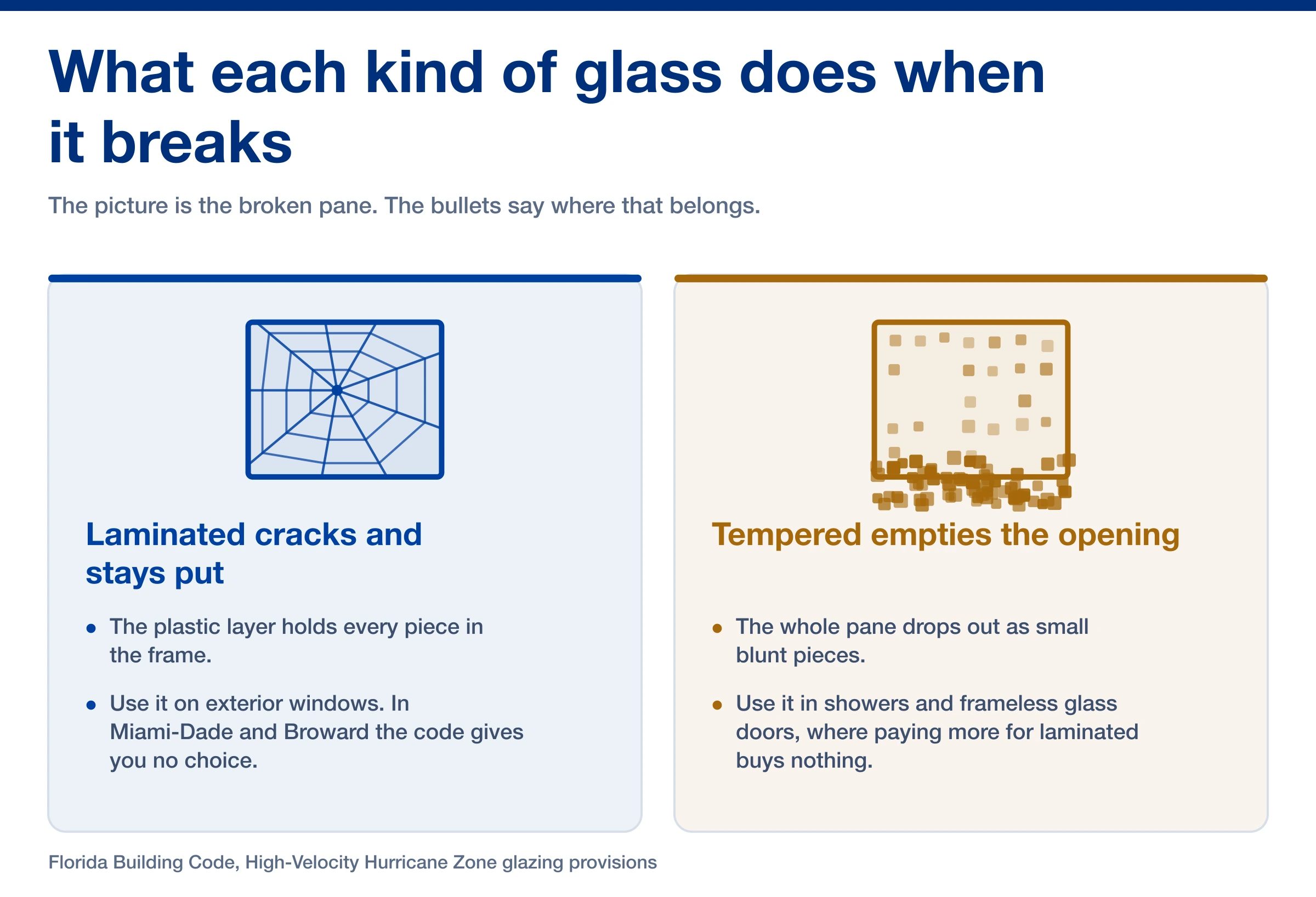
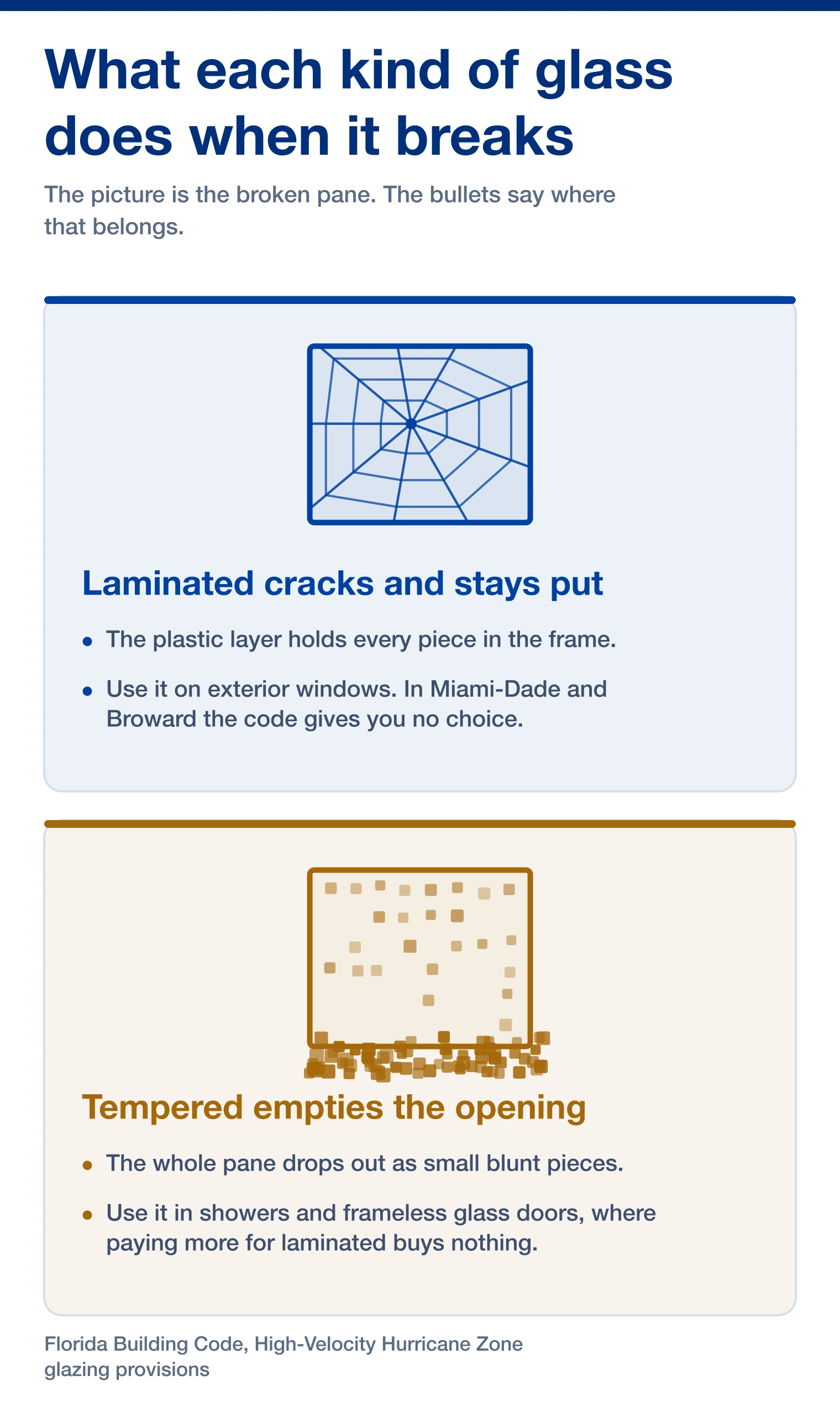
That locked-in push and pull is what makes the finished pane several times harder to break than plain glass. When something does finally break it, the tension releases everywhere at once, and the entire pane drops into small blunt pieces about the size of a corn kernel.
That is why it is in your shower door. It is also why the opening is wide open the second it goes.
Laminated glass
Laminated glass is two thinner sheets with a clear sheet of plastic between them, pressed together with heat until the plastic grips both faces. Your car windshield is the version of this everyone has already seen.
Hit it hard enough and the glass does crack, in a spider web you can see straight away. The pieces stay glued to the plastic in the middle, so the pane holds its shape in the frame. The window is ruined and you will be replacing it, and the hole in your wall stays covered in the meantime.
Why Does "Impact Glass" Mean Two Different Tests?
Here is the part that clears up most of what you read online. The word impact is used for two separate tests, written by two different groups, for two different reasons.
A pane can pass one of them and fail the other. That is exactly how a shop can tell you a window is impact rated without meaning storm rated.
Test one is about people
The first test asks whether glass will hurt somebody who walks into it. The Consumer Product Safety Commission wrote the federal rule for architectural glazing, and the Florida Building Code points at that rule for glass in doors, showers and tubs.
A weighted bag swings into the pane, and the pane has to take the hit without breaking into anything that would badly cut a person. Tempered and laminated glass both pass, which is why both of them earn the name safety glass.
Test two is about a 2x4 in the wind
The second test does not care about cuts at all. A machine fires a length of 2x4 lumber at the window, and then a pump pushes and pulls air against it thousands of times to copy hours of storm pressure.
Miami-Dade and Broward run their own version of this with a heavier board thrown faster, and the lighter statewide version is not accepted in those two counties. The table below has both sets of numbers.
What the standard is checking is not whether the glass survived. ASTM E1996, the hurricane standard the code names, says it is there to judge whether the building envelope can "remain unbreached" during a hurricane.
A pane that broke into pieces and fell out cannot keep an opening closed. So one sheet of tempered glass does not give you storm protection no matter how strong it is, and that is why the glass inside an impact window is laminated.
| What it is called | Who wrote it | What hits the glass | What passing it proves |
|---|---|---|---|
| Safety glazing | The Consumer Product Safety Commission, in its federal rule for glass in buildings | A weighted bag swings in. Panes of 9 square feet or less take 150 foot-pounds, bigger panes take 400 | The glass will not badly cut a person who walks into it |
| Large missile impact | Miami-Dade County, in its own test protocols, and ASTM for the statewide version | A 2x4 is fired at the pane, 9 pounds at 50 feet per second in Miami-Dade and Broward, then 9,000 air pressure cycles | The opening stays closed through a hurricane |
Laminated Glass vs. Tempered Glass: Where Florida Code Picks for You
Two of these decisions are not yours to make, and they run in opposite directions. One takes tempered glass off the table and one puts it there by name.
Start with the storm openings. The Florida Building Code calls Miami-Dade and Broward the High-Velocity Hurricane Zone, and in that zone it requires Product Approval on every exterior wall covering, every skylight, and every window whether it opens or not.
Approval is granted to the finished unit, frame and glass together, rather than to a type of glass. You can look any approval up yourself in Miami-Dade County's product control database, which lets you filter for the High-Velocity Hurricane Zone and read what was tested.
Now for where tempered glass is required and a laminated pane will not do. The code says a swinging or sliding door made of glass with no continuous frame around it has to be fully tempered glass, no thinner than three eighths of an inch. A laminated pane does not satisfy that one.
A skylight gets its own rule: laminated with a plastic layer of at least 30 thousandths of an inch, or tempered with a screen fitted underneath to catch the glass if it breaks.
All of this is the Florida Building Code, 8th Edition (2023), which the Florida Building Commission lists as effective December 31, 2023 and which is the edition in force today. These rules decide which glass goes in your opening. The glass is still the cheaper half of the job, and our guide to window glass replacement cost lists laminated glass cost per square foot next to tempered.
Does Stick-On Hurricane Film Count Instead?
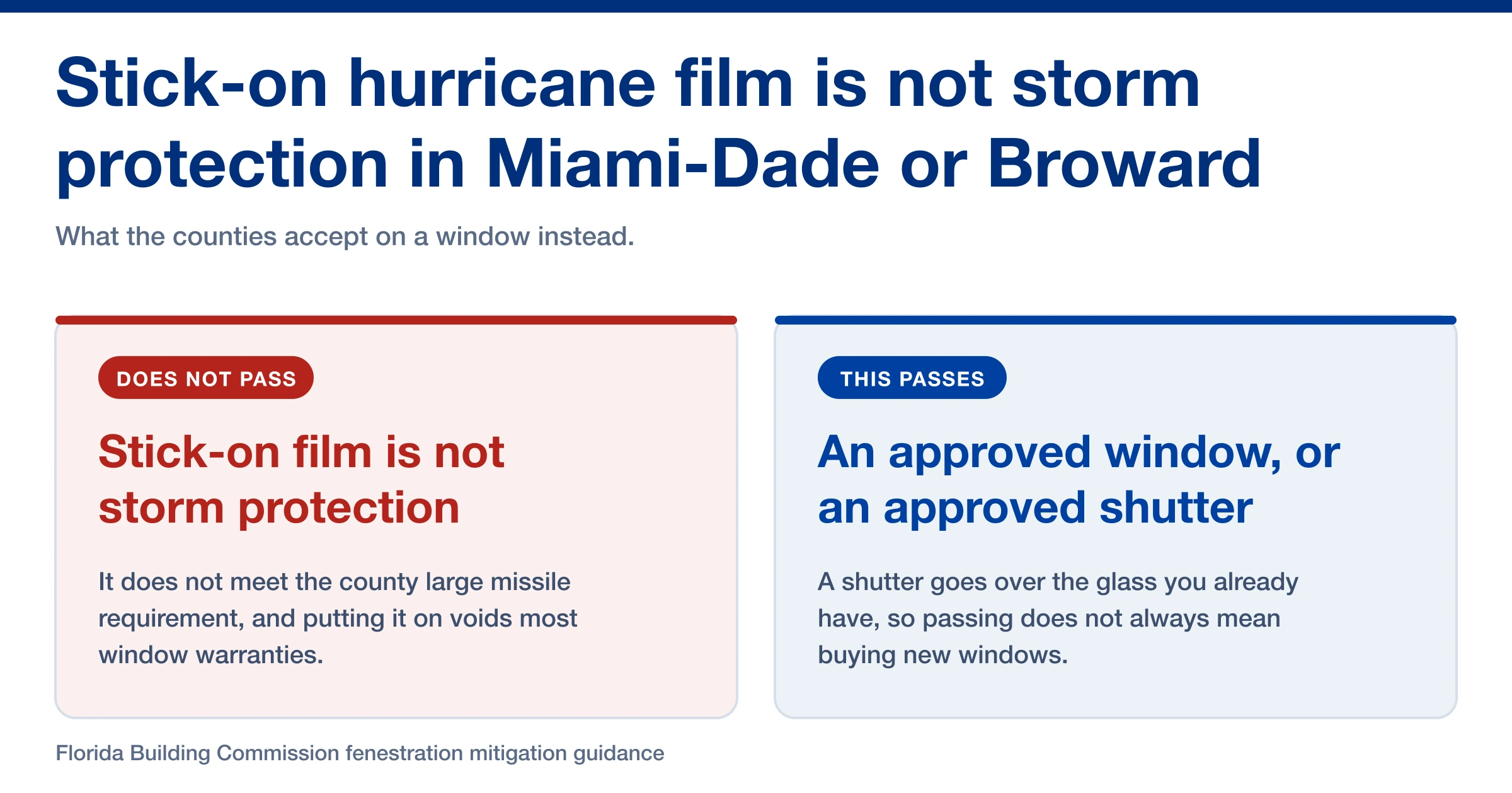
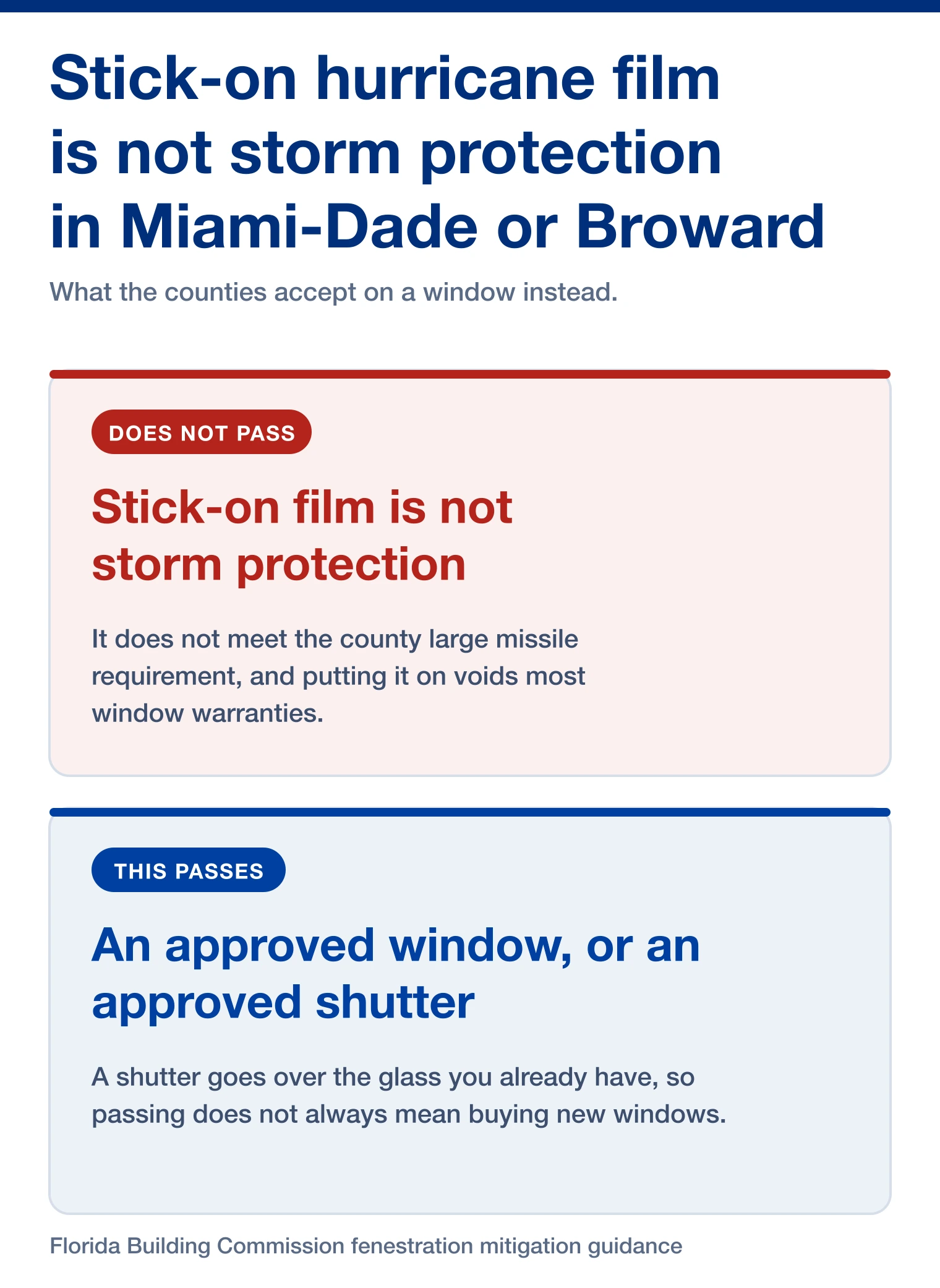
No, and this is the one people most want to be wrong about, because film is a few hundred dollars against a few thousand.
The Florida Building Commission publishes its own training material on the window and door sections of the code. It says field-applied films generally do not meet Miami-Dade County's large missile impact requirement. Putting one on also voids most window warranties.
What does count is an approved window, or an approved shutter over the glass you already have. Film is genuinely useful for holding a broken pane together and for cutting glare, so it is not a scam. It is just not the thing an inspector in Miami-Dade or Broward is looking for.
3 Questions to Ask Before You Order a Pane of Glass
These are the three we work through on a quote, in the order they come up. Read them out loud to whoever is giving you a price.
- "Which kind of glass is in there now?" There is a permanent mark etched into one corner of every pane, and the code says what it has to carry. A tempered pane is stamped by the company that made it. A laminated pane is stamped with the name of the laminator, the total thickness, and the brand name of the plastic layer inside. Ask whoever is quoting you to read that corner to you over the phone.
- "How far off the ground is this window?" Under 30 feet, a storm-zone window has to beat the big 2x4. Over 30 feet it faces the smaller missile. On a townhouse or a low-rise unit that question decides which approved products you can even order.
- "If this is a storm-rated window, what glass does its approval name?" Ask for the approval number, then ask which glass build that approval names. Our impact window repair quotes start with this question, and it is the one a cheap phone estimate skips.
FAQ
Can tempered glass be cut down to size after it is made?
No. The squeeze and stretch locked into a tempered sheet is holding the whole pane together, so cutting it, drilling it or even grinding the edge releases all of that at once and the pane falls apart on the bench.
Tempered glass has to be ordered at its finished size, with any holes already in it. Laminated glass can be cut, which is one reason a laminated pane is often the easier same-week fix.
Is laminated glass the same thing as impact glass?
No, and the two words are not even the same kind of word. Laminated describes how a piece of glass was built, and you can buy it by the square foot.
Impact glass is what the trade calls a finished window that passed the missile test. So laminated glass is an ingredient, and an impact window is the finished product you order.
I am not in Florida. Which one does my local code want?
The safety glazing rules are federal, so glass in a door, a shower and the spots right beside them has to be tempered or laminated anywhere in the country.
The hurricane requirement is the part that changes, and your building department will tell you in one phone call whether your address sits in a wind-borne debris zone.
In the New York City buildings we work in, nobody has ever asked us for impact glass. What they ask for is the managing agent's paperwork and a freight elevator slot.
Getting the Right Glass in Florida or New York
If nobody has told you which glass your opening takes, ask for that in writing before you pay a deposit. We give free estimates across Miami-Dade, Broward, Palm Beach and the New York City area, and we will read the stamp in your window for you.
Code sections, test figures and the current code edition on this page were read against their own sources on October 1, 2026. Your own city or county may add rules on top of the state ones, so confirm anything permit-related with your building department.