
A crack runs across one pane, or one window has gone so cloudy you cannot see the yard through it. You call around, and the number that comes back is a lot bigger than you pictured for one piece of glass. So you are stuck on three questions. Is this price fair? Should you replace the whole window while someone is already out there? And can anyone even cut a new pane for the window you have? We do glass repair and cutting and impact window repair in Florida and New York, so we price this work every week. By the end you will know what the glass itself costs, why your quote is bigger than that, the five things that move the price, when a whole new window is the only legal option, and what changes in Florida and New York.
Expect roughly $170 for a small clear pane and up to about $640 for a big laminated one, with most single window jobs landing in the middle.
- The glass is the cheap part. It runs $8.05 a square foot for thin clear glass and $21.33 for laminated.
- Labor is the expensive part, at $80 an hour during business hours and double that after 5pm or on a weekend.
- A fogged double pane window needs the whole sealed unit rebuilt, not one pane, so it costs more than a single pane break.
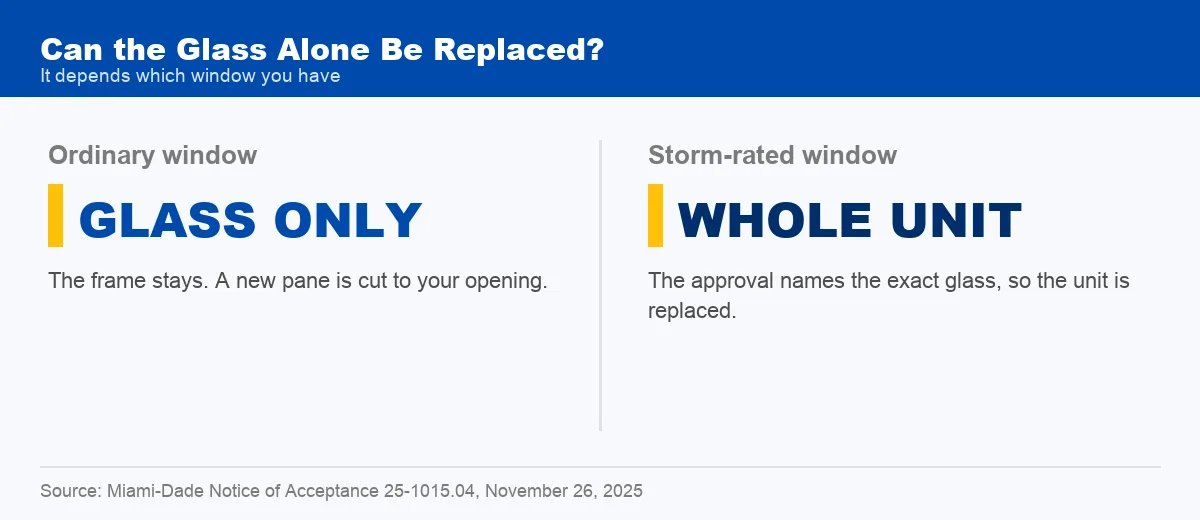
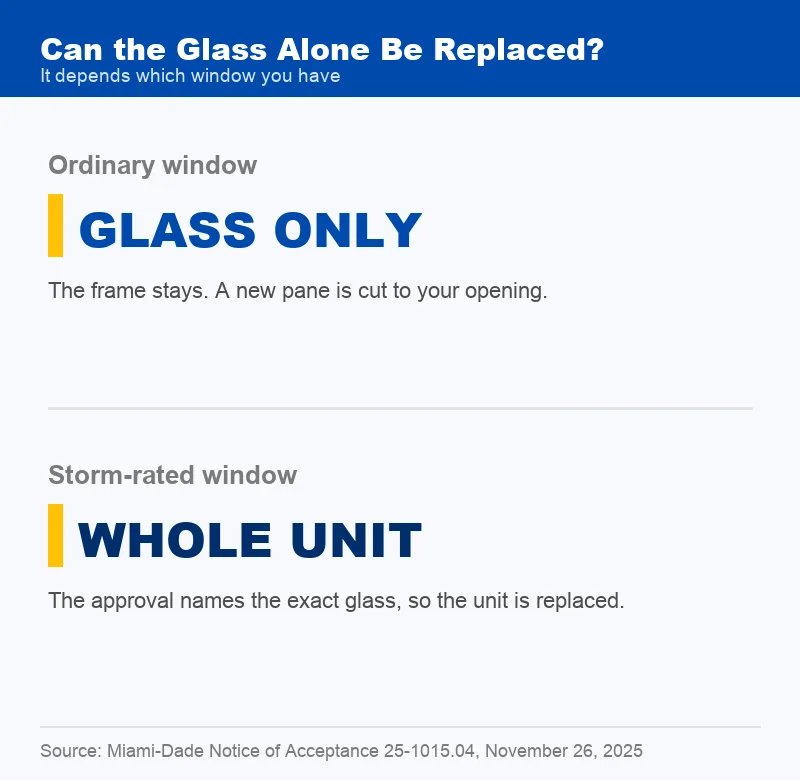
- Storm-rated windows are approved as a complete unit, so on those the glass usually cannot be swapped on its own.
Where these numbers come from: the glass and labor rates are the awarded prices in the City of San Antonio building glass contract opened October 1, 2025, a public record of what a glass company actually charges a customer that buys in volume.
- Book the work for a weekday morning. Timing moves this bill more than the glass does.
- Find out whether you have one pane or a sealed unit before you compare quotes, because they are two different jobs.
- Treat safety glass near a door as a requirement rather than an upsell.
- If the frame is rotted or out of square, new glass will crack again. Fix the frame or replace the window.
Why the Quote Is More Than the Glass
Here is the part that makes the number stop feeling like a rip-off. When a city puts its glass work out to bid, every line is public, so you can see the pieces of a price that a homeowner only ever sees added up. In the San Antonio contract, the glass is priced by the square foot and the labor is priced by the hour, separately.
| Glass type | Per square foot |
|---|---|
| Single strength clear (thin, old wood windows) | $8.05 |
| Double strength, any color | $8.55 |
| Triple strength clear | $10.88 |
| Tempered, 3/16 inch, clear | $10.88 |
| Plate glass, 1/4 inch, clear | $15.69 |
| Tempered, tinted gray or bronze | $16.22 |
| Laminated, 1/4 inch, clear | $19.95 |
| Laminated, 1/4 inch, tinted | $21.33 |
Now do the math on a real window. An average bedroom window is about 12 square feet. In clear tempered glass that is roughly $131 of material, and two hours of labor at $80 an hour adds $160. You are at about $291 before anything else. A small clear pane in an old wood sash lands nearer $170, and a large laminated piece can reach $640. A quote for one window in your house usually sits a little above those numbers, because a single stop is not a volume job and the trip costs the same whether the pane is small or large.
Two other lines in that contract explain the quotes that come back much higher than you expected, and they have nothing to do with the glass.
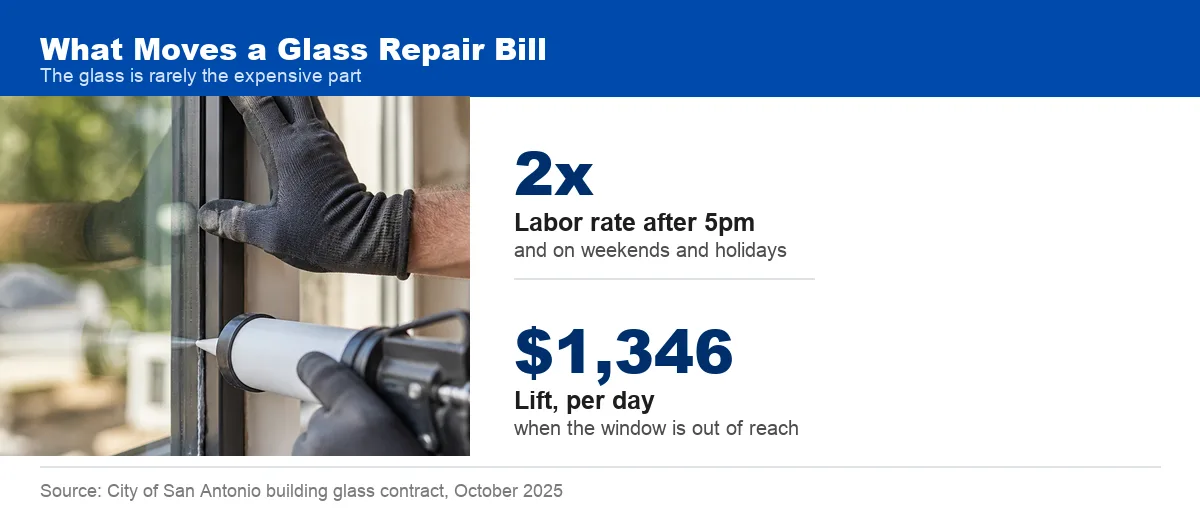
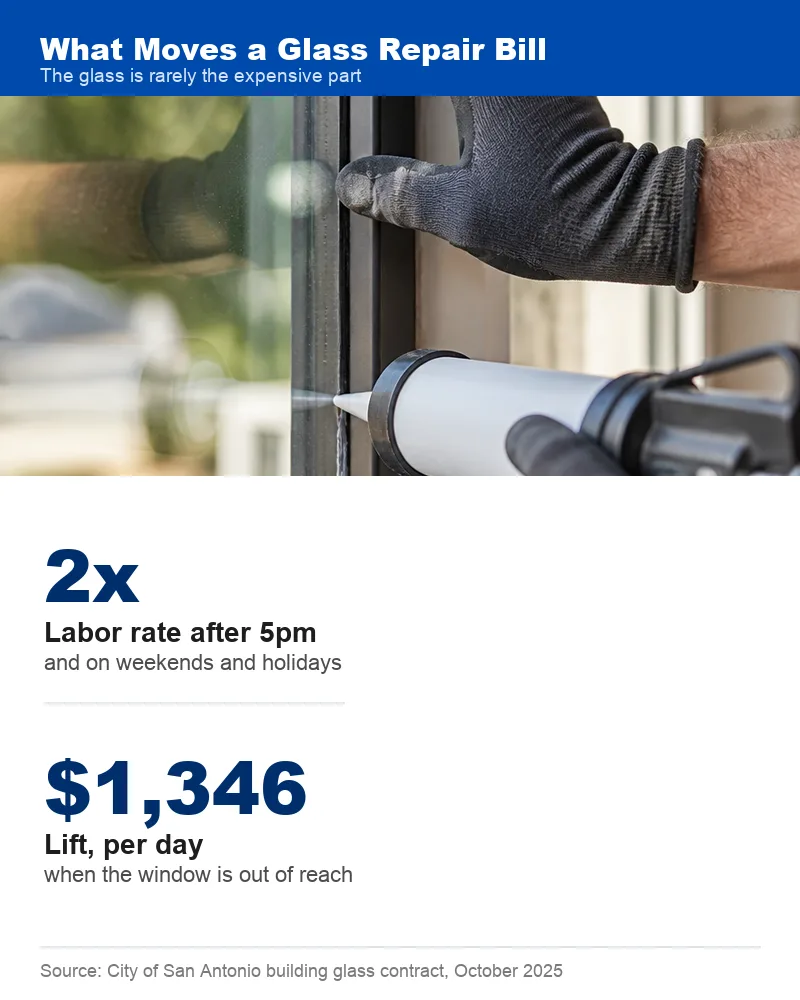
So if you call at 6pm on a Friday about a broken window, you are buying the doubled rate. If the window sits three floors up with no balcony, someone has to bring a lift, and that is a day charge no matter how long the pane takes to set. Booking the repair for a weekday morning is the single easiest way to pay less. That leaves the bigger question of what you are replacing in the first place.
Can You Replace Just the Glass?
Usually yes, and it is normally the cheaper path, because the frame, the sash and the hardware all stay where they are. What decides it is which of three things went wrong.
A single pane broke
This is the simple one. The old glass comes out, the frame gets cleaned up, and a piece cut to your measurements goes back in. Older windows hold their glass in putty, newer ones in a rubber gasket or a bead of sealant, and either way the window is whole again the same day the glass arrives.
A double pane window fogged up
The haze between the panes means the seal around the edge has failed and moist air got in. Nobody replaces one side of that. The two panes and the spacer between them are one factory-made part, called an insulated glass unit, and the whole unit gets swapped. It costs more than a single pane, but it is still far less than a new window, and the frame you already have keeps working.
The frame itself is the problem
If the sash is rotted, the frame is out of square, or the window will not lock or stay open, new glass fixes nothing. Putting fresh glass in a failing frame is the one version of this job we talk people out of, because the new pane tends to crack again once the frame moves. That is when replacing the window is the honest answer.
5 Things That Change What You Pay
These come up on almost every estimate, roughly in the order they move the price.
- How big the pane is. Glass is sold by the square foot, so area drives the material cost directly. Doubling the size of the pane roughly doubles the glass on your bill, though the labor stays about the same.
- Whether safety glass is required. Glass in and around doors has to be tempered or laminated, and that glass costs about twice what plain glass costs. It is not an upsell when a shop tells you this, and the next section covers who decides it.
- Single pane or a sealed unit. One piece of glass is stock. A sealed double pane unit is built to order for your opening, which adds both cost and a wait.
- How hard the window is to reach. Ground floor with a clear path is the cheap version. Upper floors, tight side yards, and anything needing a lift add more than most people expect.
- How fast you need it. A weekday appointment is the base rate. Nights, weekends and emergency board-ups all cost more, and a temporary board-up is a separate visit from the glass going in.
That covers the ordinary windows. There is a set of windows where none of this applies, because swapping the glass is not on the table at all.
When You Cannot Just Swap the Glass
Two rules decide this, and most articles about glass pricing skip both. The first is federal and it covers doors rather than windows. According to title 16, part 1201 of the Code of Federal Regulations, glazing used in storm doors, doors, bathtub doors and enclosures, shower doors and enclosures, and sliding glass patio doors has to meet a federal safety standard. So a shop cannot simply cut you a plain pane for a sliding patio door. It has to be safety glazing, which is why that glass carries a permanent stamp in one corner.
The second rule is the one that surprises people, and it applies to storm-rated windows. An impact window is not approved as a frame with some glass in it. The whole assembly is tested and approved together, and the approval names the exact glass build. Look at Miami-Dade Notice of Acceptance 25-1015.04, approved on November 26, 2025: it lists the specific approved glass interlayers by product name and by their own approval numbers. Cut a different piece of glass for that window and the approval no longer covers it.
What Changes in Florida and New York
In Florida the paperwork is the difference. Miami-Dade County's permit checklist for new windows and glass doors says the applicant must indicate which glass type and thickness is being used, tied to the product approval. That is why a real quote on a storm-rated window asks which unit you have before it gives you a price, and why the cheapest phone quote is often the one that skipped the question. Worth knowing while you budget: the federal credit that used to pay toward window work is gone, which we cover in our guide to the window and door tax credit in 2026.
In New York City the glass costs the same. What adds to the bill is getting into the building. A freight elevator reservation, a certificate of insurance for the managing agent, and co-op approval all take time before anyone touches the glass, and in a walk-up the pane goes up the stairs by hand. None of that shows up in a national average. Booking the measuring visit and the install visit on the building's schedule, rather than yours, is what keeps a city job from turning into three trips.
FAQ
Why does the shop measure the opening instead of the broken pane?
Because glass is cut to order and cannot be returned. A cracked pane may have shifted, and old frames rarely sit square after years of settling. Measuring the opening itself, in three places, is how a shop keeps from cutting a piece that will not go in. If someone quotes you from a photo without measuring, expect a second trip.
Why does the new pane look slightly different from my other windows?
Because glass is made in batches, and the tint of clear glass shifts a little from one production run to the next. Your other panes have also had years of sun on them. In direct light a fresh pane can read slightly greener or brighter than its neighbors for a while. If an exact match matters to you on a front-facing window, say so before the glass is ordered, because it changes what the shop pulls.
Does the new glass have to match what was there before?
On an ordinary window, no. Thickness and tint should match so the window still looks right and the sash holds it properly, but you can upgrade. On a storm-rated window, yes. That glass is part of an approved product, so the replacement has to match the approval rather than just the look.
Is it worth upgrading to a sealed double pane unit while the window is open?
It can be, and the labor is already paid for either way, so the upgrade only costs you the difference in the glass. The catch is the frame. A sash built for a thin single pane often will not hold a thicker sealed unit without modification, and that turns a glass job into a window job. Have someone check the sash depth before you decide.
Getting a Glass Quote in Florida or New York
If you have a cracked pane or a window that has gone cloudy, get the quote itemized so you can see the glass, the labor and any access charge as separate lines. We give free estimates across Miami-Dade, Broward, Palm Beach and the New York City area, and we will tell you straight whether the glass alone fixes it or the frame is the real problem.
Prices here come from a public agency contract and are a guide, not a quote. Glass rates, labor rates and product approvals change. Every figure on this page was checked against its own source on September 3, 2026.