
You get a quote for new windows, and the price is softened by a federal tax credit that is supposed to pay part of it back at tax time. That credit, the one homeowners have been claiming on windows and doors for years, ended on January 1, 2026, and a quote built around it is a quote with a hole in it. We install and replace impact windows and patio doors in Florida and New York, and this question now comes up on almost every estimate. By the end you will know which credit ended and when, whether windows you installed in 2025 can still be claimed, the four mistakes we hear most on quotes right now, and what Florida and New York homeowners can still use in 2026.
No. There is no federal tax credit for new windows or exterior doors placed in service in 2026.
- The Energy Efficient Home Improvement Credit, known as Section 25C, ended for property placed in service after December 31, 2025.
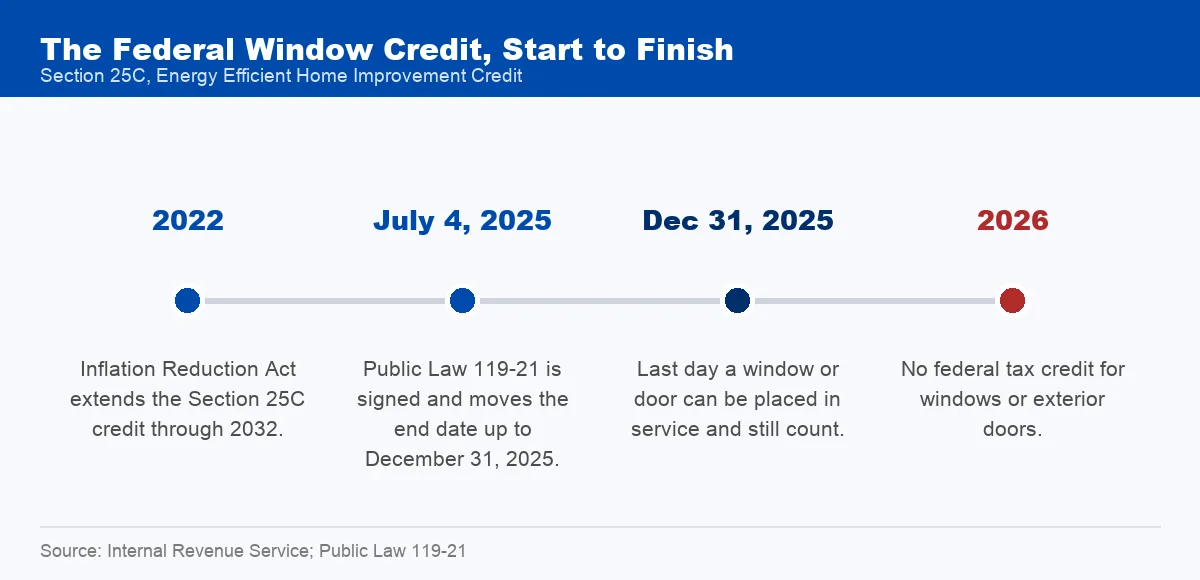
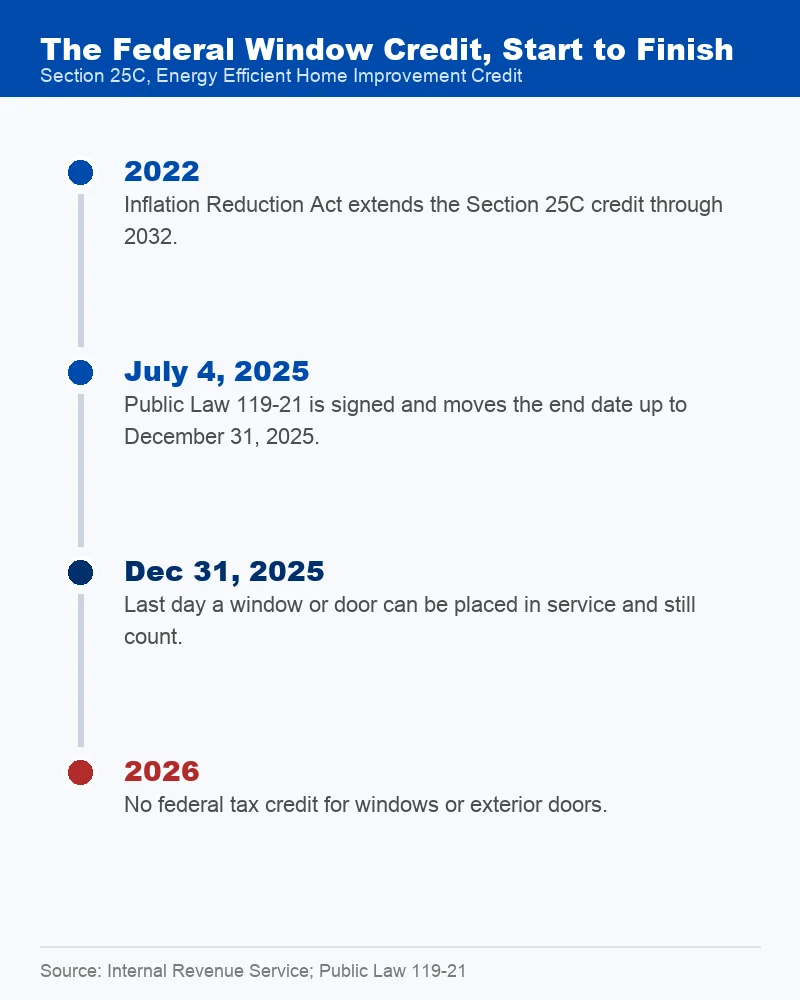
- The law that ended it, Public Law 119-21, was signed on July 4, 2025. It cut the credit six years short of its old 2032 end date.
- Windows finished and working in 2025 can still be claimed on a 2025 tax return, and a manufacturer number is required to do it.
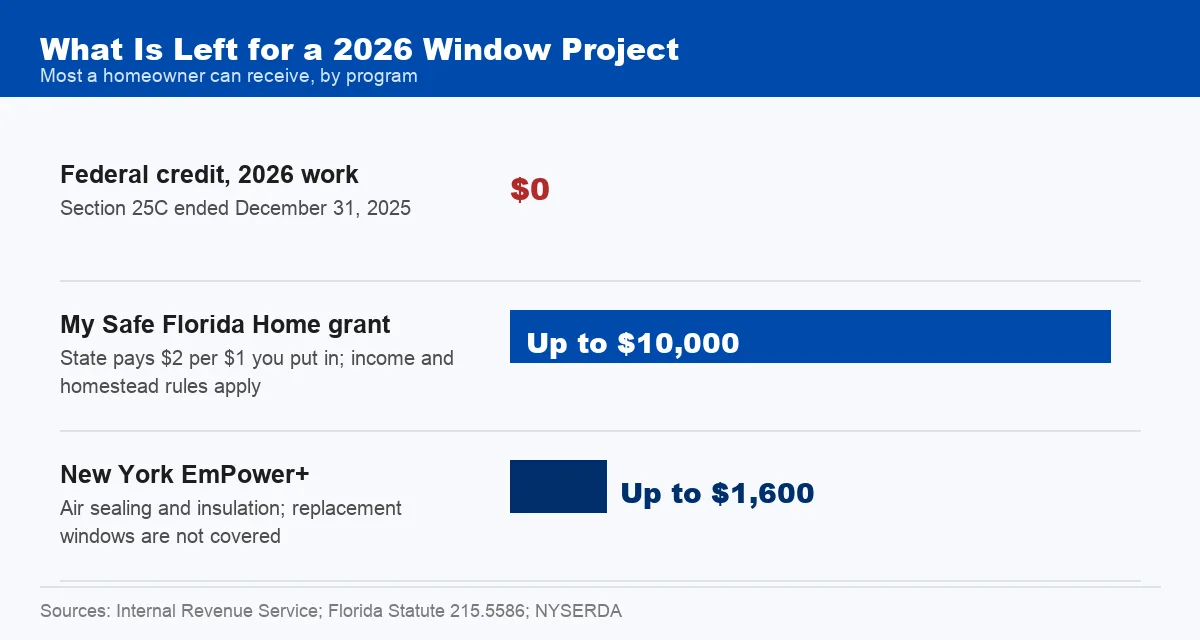
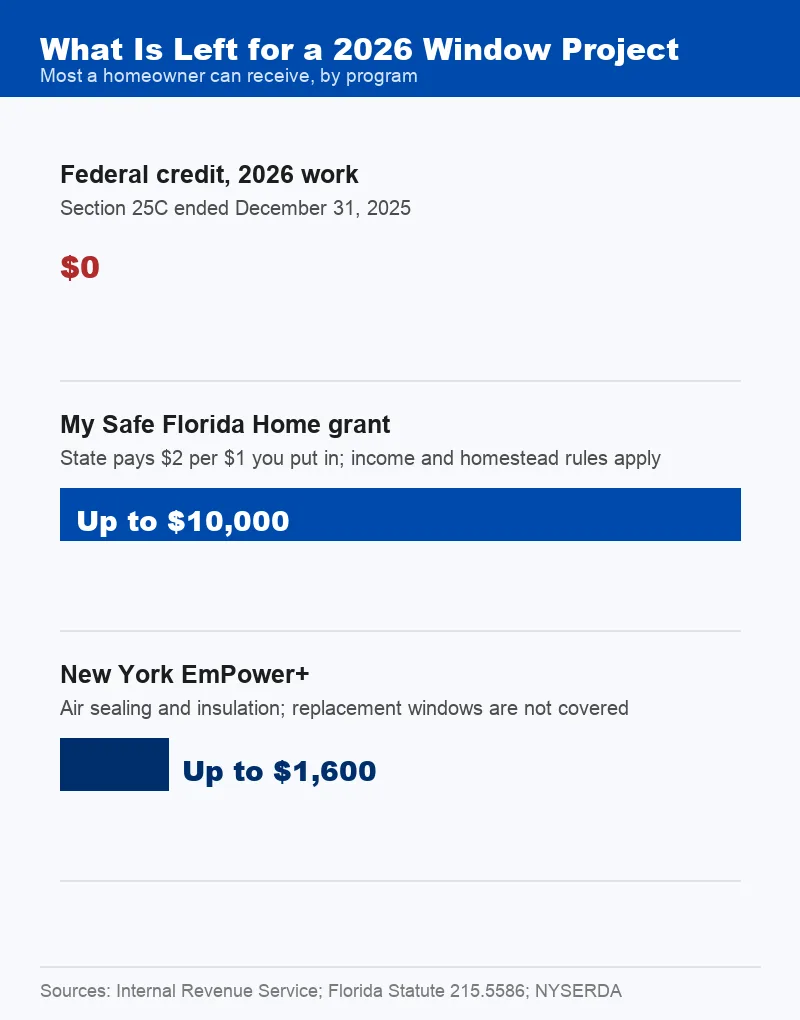
- Nothing federal replaced it. What is left is state and utility money, including a Florida grant worth up to $10,000.
Where these numbers come from: the Internal Revenue Service (IRS) page for the credit says it applies to property placed in service before December 31, 2025. Public Law 119-21 is the law that set that date.
What the Window Tax Credit Was, and Exactly When It Ended
Section 25C paid homeowners back a share of what they spent on energy efficient improvements, windows and exterior doors included. The 2022 Inflation Reduction Act had extended it through 2032. Section 70505 of Public Law 119-21, signed July 4, 2025, replaced that end date with December 31, 2025. Anything placed in service after that day gets nothing.
The words "placed in service" carry the whole rule. According to the IRS, that is the date the item is installed and in use. Not the day you signed. Not the day you paid a deposit. Not the day the glass arrived on the truck. Here is what the credit was worth while it ran.
| Item | Most it could pay | Catch |
|---|---|---|
| Exterior windows and skylights | $600 total | Had to meet ENERGY STAR certification rules |
| Exterior doors | $250 per door, $500 total | Applies to the door, not the frame work around it |
| All 25C improvements in one year | $1,200 | Shared with insulation and other upgrades |
Can You Still Claim a 2025 Install?
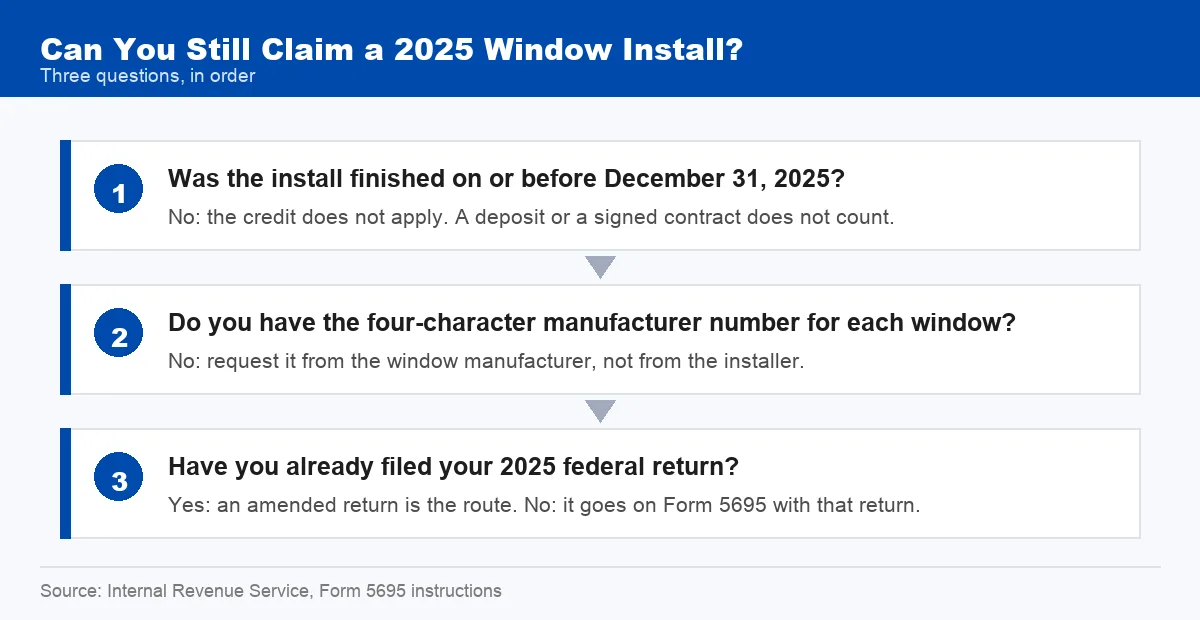
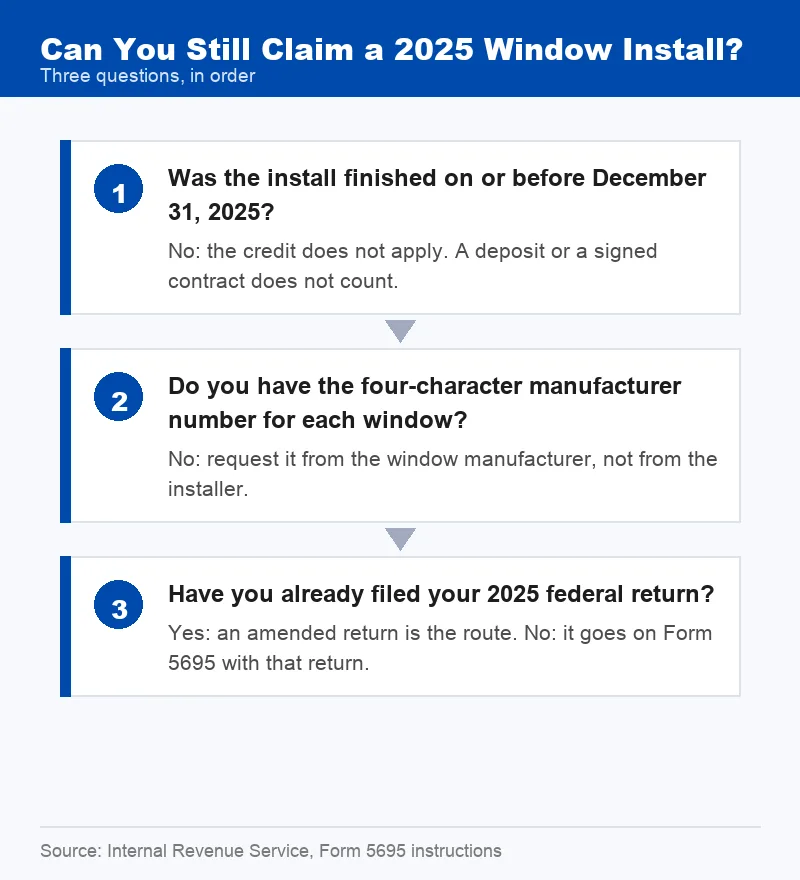
Yes, if the work was finished on or before December 31, 2025. The claim goes on a 2025 federal return. One rule trips people up more than any other. For 2025 work, the Form 5695 instructions ask for a short code on each item, four characters long. The IRS calls it the qualified manufacturer identification number. Line 20a is where your four priciest windows and skylights go, each with its own code. No code, no credit for that item.
That code comes from the window maker, not from the installer. Ask your supplier for it and keep it with the invoice. Already filed your 2025 return and left the credit off? You can fix that with an amended return. The IRS gives you three years from the day you filed, or two years from the day you paid the tax, whichever is later. If you took an extension for 2025, you have not filed yet. An amended return only corrects a return you already sent, so claim the credit on the original one when you file it.
4 Things We Hear on Quotes Now
These four come up week after week on estimates in Broward, Miami-Dade, Palm Beach and New York City. Each one costs a homeowner real money if it goes unchecked.
1. "My December deposit counts."
It does not. The credit follows the date the window was installed and in use. A deposit paid in December 2025 on a job that finished in February 2026 sits on the wrong side of the line. If a salesperson tells you a deposit locks in a credit, ask them to show you where the IRS says so.
2. "Florida still sells impact windows tax free."
That ended more than two years ago. The Florida Department of Revenue exemption on impact-resistant windows, doors and garage doors ran from July 1, 2022 through June 30, 2024. Sales tax has applied since July 1, 2024. Ads still repeat it, so check the quote for a line that removes tax you actually owe.
3. "ENERGY STAR windows got the credit automatically."
Certification was one condition, never the whole test. Even in 2025 the item also needed that maker code on the return. ENERGY STAR still helps in 2026 for a different reason. Its rebate finder lists utility rebates by zip code, and utility money is one of the few sources left.
4. "A new credit replaced it."
Nothing federal replaced it for windows or exterior doors. What usually gets called a replacement is a state grant or a utility rebate, and those are not federal money at all. They come with their own rules, income limits and sign-up windows. The two that matter in our service areas are next.
What Florida Homeowners Can Still Use
The real money in Florida is My Safe Florida Home , a state program that pays for hurricane hardening. It funds opening protection, which by statute includes exterior doors, garage doors, windows and skylights, plus roof work. Applications run through the state portal and start with a free wind mitigation inspection.
The terms come straight from Florida Statute 215.5586, last amended in 2025:
- Up to $10,000 from the state toward the project.
- The state pays $2 for every $1 you put in, and low-income homeowners are not required to put in a matching amount at all.
- You need a homestead exemption on the home.
- The home's first building permit must have been applied for before January 1, 2008. The insured value must also be $700,000 or less, though low-income applicants are exempt from that cap.
- A hurricane mitigation inspection within the previous 24 months has to be on file when you apply.
The grant money is finite and awarded as applications come in, so the calendar matters more than it does with a tax credit. One more Florida item worth a phone call: hardened openings feed the windstorm portion of your home insurance premium. Ask your carrier what it wants documented before the work starts, not after.
What New York Homeowners Can Still Use
New York money is income based and aimed at the building envelope rather than the glass. EmPower+ is run by the New York State Energy Research and Development Authority. It covers air sealing and insulation up to $1,600, heat pumps up to $8,000, and electrical panel work up to $4,000. Owners and renters of one to four family homes qualify by income. Low-income households can receive no-cost improvements capped between $12,000 and $14,000 depending on the region. Moderate-income households get half the cost covered, up to $6,000 or $7,000.
Read the covered list closely: replacement windows are not on it. If drafts are the complaint in a Brooklyn or Queens apartment, the program will pay to seal and insulate before it pays for glass, and that order is usually the right one anyway. For anything beyond that, the utility rebates in the ENERGY STAR finder are the next place to look.
Is a Better Window Still Worth It?
The credit was capped at $600 for all the windows in a house. On a whole-home job that was a rounding error, which is why losing it changes the math less than the headlines suggest. The larger number is the one that never depended on Congress: according to the U.S. Department of Energy , heat gain and heat loss through windows are responsible for 25 to 30 percent of residential heating and cooling energy use.
So the case for a better window in 2026 rests on the power bill, on the insurance side in Florida, and on not paying twice because the first install leaked. We see that second bill often. A cheap unit set in a frame that was never flashed correctly costs more over ten years than the credit ever returned.
One more thing worth checking before you price a whole new unit. If a single pane broke or one window fogged up, the glass on its own is often the cheaper fix, and our guide to window glass replacement cost covers what that runs and when it is not an option.
FAQ
My windows were delivered in December 2025 but installed in January 2026. Which year counts?
The install year. The IRS ties the credit to the date the property was placed in service, which is when the installation is finished and the window is in use. A delivery, a deposit, or a signed contract in 2025 does not move a January 2026 install into the 2025 tax year.
Did the credit cover installation labor on a 2025 window job?
No, and this surprises people. The Form 5695 instructions say not to include amounts paid for the onsite preparation, assembly, or original installation of a building envelope component, which is what a window, skylight or exterior door is. Only the product cost counted. Labor did count for other items such as heat pumps, which is a separate part of the old credit.
Do impact windows qualify for anything in Florida just for being impact rated?
Not for a tax credit. It matters for two other things. The My Safe Florida Home grant pays for opening protection, and impact windows count. Your home insurance also prices the storm part of your premium from a wind mitigation inspection. Ask your carrier what paperwork it wants before the work starts.
Can a renter or a landlord use the My Safe Florida Home grant?
No. Florida Statute 215.5586 requires that the applicant has been granted a homestead exemption on the home. That rules out rentals, second homes, and investment property. The home also has to have been permitted before January 1, 2008.
Will the federal window credit come back?
Congress can restore a credit at any time, but as of August 13, 2026 no enacted law brings back a federal credit for windows or exterior doors. Treat any quote built on a credit that might return as a quote with a hole in it.
Getting a Quote in Florida or New York
If you are pricing windows or doors this year, get the quote itemized so you can see the product, the labor, the permit and the tax as separate lines, with no credit baked in that no longer exists. We give free estimates across Miami-Dade, Broward, Palm Beach and the New York City area. We will also tell you straight whether a repair holds for another season or the unit is done.
This is general information, not tax advice. Program rules, grant funding and filing deadlines change. Talk to a tax professional about your own situation, and check program terms with the agency before you sign a contract. Every figure here was checked against its own source on August 13, 2026.